Why the timing of when you review something matters more than how carefully you read it — and two methods that work without flashcards.
Spaced repetition — returning to material at increasing intervals and retrieving from memory before re-reading — produces dramatically stronger long-term retention than reviewing immediately. A study by Cepeda et al. found the optimal spacing interval produced a 64% increase in long-term recall. Two practical methods for professionals: the return-to list (48 hours out, reconstruct before re-reading) and the weekly 15-minute review.
You read something genuinely useful last week. A framework, a study, a case study directly relevant to a challenge you're navigating. It felt like it landed.
Two weeks later, in a meeting where it would have been directly applicable, you reached for it and found almost nothing usable.
This is not a memory problem. It's a timing problem.
The research on how memory consolidates over time points to one of the most counterintuitive findings in learning science: the best time to review something is not immediately after reading it. It's after you've forgotten some of it.
This is the principle behind spaced repetition.
What Spaced Repetition Actually Is
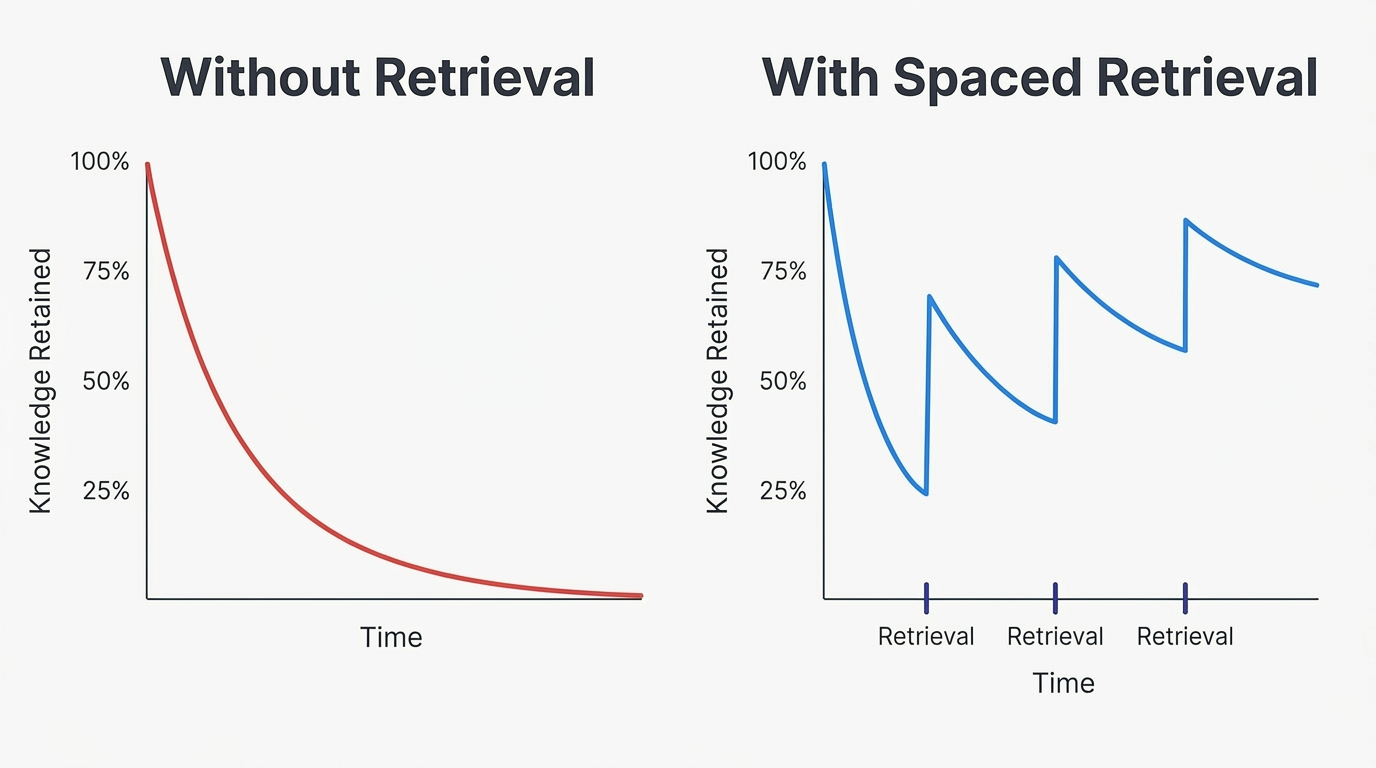
Spaced repetition is the practice of returning to material at increasing intervals — and at each interval, retrieving from memory before looking at the source.
Two things matter in that definition.
The gap. Not reviewing immediately, but waiting. The gap allows some forgetting to set in, which is exactly what makes the next retrieval produce stronger consolidation.
Retrieval, not re-reading. When you return to material, the first step is reconstructing what you remember without looking. Then check the source for what you missed.
Spaced repetition is not re-reading an article every few days. It is not reviewing your highlights. It is not asking AI to summarize the same article again. All of those feel like they should work. None of them produce the gains spaced retrieval produces.
The Evidence
64% More Recall From the Right Timing
In 2008, Cepeda et al. tested over 1,350 people across 26 different spacing conditions.
Need something for a meeting next week? A gap of a day or two works well. Need it for a strategy conversation a month from now? Wait a week or more before reviewing.
Gains That Hold for Two Years
Kerfoot and colleagues tested medical professionals — working professionals with active clinical responsibilities, not students — who received weekly spaced retrieval prompts on clinical content.
At 6–8 months, they showed measurably more knowledge than those who didn't. A two-year follow-up found the gains still held.
Not two days. Two years — from a simple habit of returning to material at spaced intervals and retrieving before re-reading.
Why It Works — Reconsolidation
When you retrieve a memory from long-term storage, the brain reactivates it, updates it with more recent context, and strengthens the neural pathways leading back to it. Then it reconsolidates — more robustly than before.
This is reconsolidation. It only happens when you retrieve, not when you re-read.
The struggle of slightly-faded recall is not a sign that learning is failing. It is reconsolidation happening. The memory returns stronger precisely because you had to reach for it.
Rapid re-reading bypasses this entirely. If you review material while it's still fresh, almost no effortful retrieval is required. The brain recognises rather than reconstructs. Familiar rather than durable.
The right question isn't "Did I re-read it?" It's "Did I reach for it — and find it?"
Two Methods That Work for Professional Reading
1. The Return-To List
Most professionals have a read-later folder. Almost nobody consistently returns to it.
The fix: a return-to list — articles worth retaining, each with a date 48 hours from when you read them.
When that date arrives:
Spend 60 seconds reconstructing what you remember. No notes, no looking.
Open the article and check what you missed.
Add it to the return-to list again — this time 1 week out.
The gap between first read and first retrieval is where initial consolidation happens. The gap between first and second retrieval is where the gains compound.
2. The Weekly 15-Minute Review
Once a week, spend 15 minutes on this:
Pick 3 things you read this week that felt genuinely important. For each one, without looking at any source, reconstruct the core argument. Note what you couldn't recall clearly — those are the gaps worth returning to.
15 minutes. One forcing function for retrieval that most reading habits skip entirely. Over months, it produces a significantly different knowledge baseline than reading without retrieval.
How Learn Better Implements Spaced Repetition
Most spaced repetition tools — Anki, RemNote, Mochi — require you to manually create flashcards for every concept worth retaining. For a student working through a fixed curriculum, this is manageable. For a professional consuming 5–10 articles per week across constantly shifting domains, it isn't sustainable.
Learn Better removes the manual overhead entirely.
When you add an article to Learn Better, it automatically extracts the key concepts worth retaining — filtering out background context and focusing on the ideas that are transferable and actionable. It then generates retrieval questions across six cognitive levels (from basic recall through application, analysis, and evaluation) and schedules them using one of the most accurate spaced repetition algorithms used in the industry.
The result: the articles you already read become a scheduled retrieval practice system, without creating a single flashcard. The right questions appear at the right intervals — timed to catch you just before the memory would fade, which is exactly when retrieval produces the strongest reconsolidation effect.
This is spaced repetition designed for how professionals actually read — not how students study for exams.
What to Try This Week
Pick one article you read in the last seven days that felt genuinely useful.
Without looking at it, write down what you remember. The core argument. The evidence. What it means for your work. Then check the source. Notice the gap. Add it to a return-to list for 48 hours from now. When you return, reconstruct before you re-read.
Two steps. Most professionals do neither. The ones who do build knowledge that's actually there when something real is asked of them.
Spaced repetition solves the retention problem — but retention was never the real goal. Being able to recall a framework means little if you can't put it to work when a live situation calls for it.
The reviews that matter most aren't the ones that ask do you still remember this? — they're the ones that ask can you use this here? Application, spaced out over time, is what turns a remembered idea into a professional instinct you reach for without thinking.
Frequently Asked Questions
Spaced repetition is a learning method where you review material at increasing intervals, retrieving from memory at each interval before checking the source. It produces significantly stronger long-term retention than reviewing immediately or not returning at all.
Re-reading involves looking at the source — the brain recognises familiar content but doesn't consolidate it as deeply. Spaced repetition involves actively retrieving from memory before looking. The retrieval effort triggers reconsolidation and produces durable memory.
Research by Cepeda et al. shows the optimal gap depends on how long you want to remember the material. A useful rule of thumb: the gap should be roughly 10–20% of your target retention interval. Need it for a week? Review after 1–2 days. Need it for a month? Review after 5–7 days.
Yes. The Kerfoot study tested working medical professionals — not students — and found significant, durable knowledge gains from spaced retrieval over a two-year period.
Retrieval practice is what you do at each review interval — reconstructing from memory rather than re-reading. Spaced repetition is the schedule — when you return. They work together: spaced repetition without retrieval is just scheduled re-reading, which produces much weaker gains.
Learn Better uses one of the most accurate spaced repetition scheduling algorithms used in the industry to automatically schedule retrieval questions from articles you read. Rather than requiring manual flashcard creation, Learn Better extracts the key concepts from each article and generates retrieval questions across six cognitive levels (recall, understanding, application, analysis, evaluation, creation). Questions are scheduled to appear at the optimal interval for your retention — timed to catch you just before the memory fades, which is when retrieval produces the strongest reconsolidation effect.
No. Flashcard software like Anki automates scheduling, but the manual card creation process makes it unsustainable for most professionals. The return-to list and weekly review methods above produce most of the benefit without the overhead. Learn Better automates both the question generation and the scheduling entirely.
Sources
- Cepeda, N.J. et al. (2008). Spacing Effects in Learning: A Temporal Ridgeline of Optimal Retention. Psychological Science, 19(11), 1095–1102.
- Kerfoot, B.P. et al. (2007). Spaced education improves the retention of clinical knowledge. Medical Education, 41(1), 23–31.
- Brown, P.C., Roediger, H.L., & McDaniel, M.A. (2014). Make It Stick: The Science of Successful Learning. Harvard University Press.
Start using what you read
LearnBetter applies spaced retrieval to the articles you already read — automatically. Get started free — no credit card required.