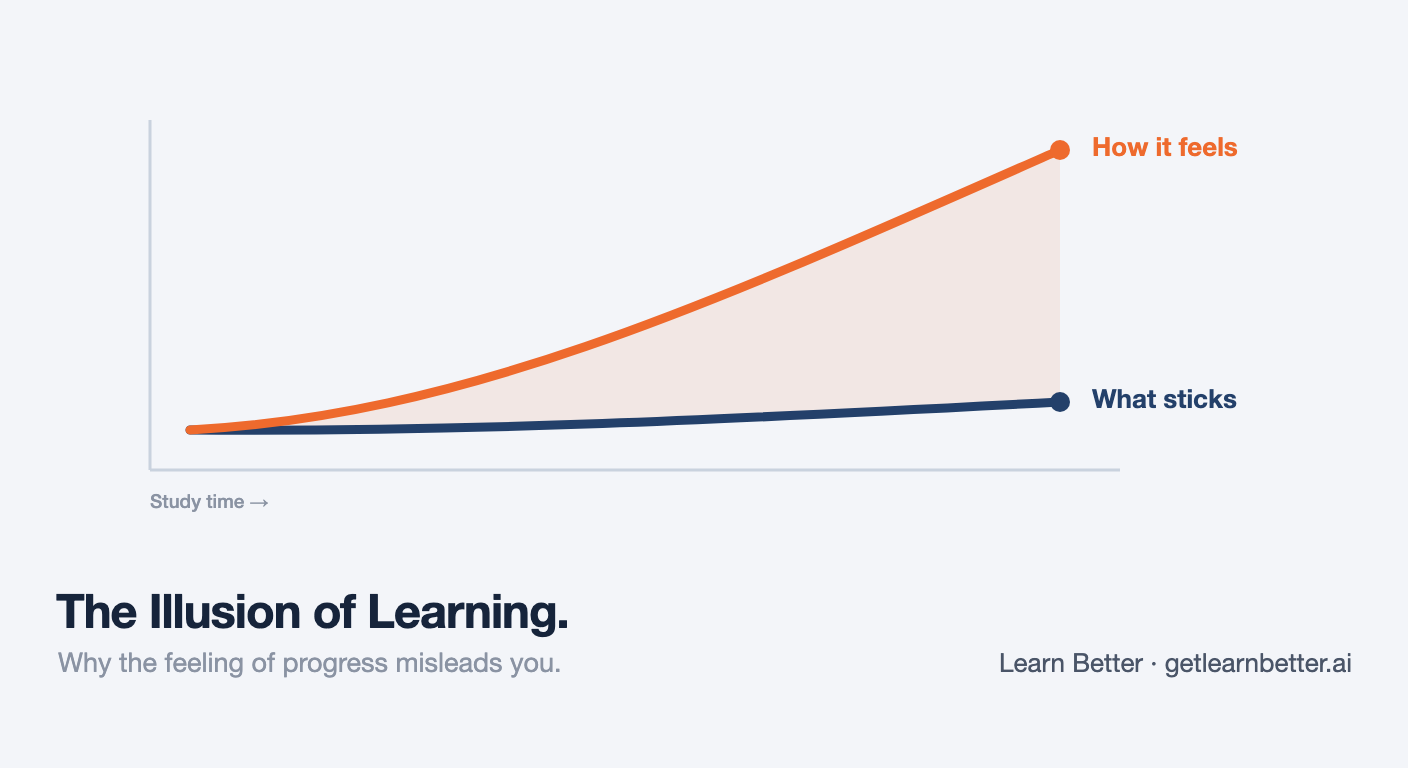
People consistently prefer the study method that produces worse results — even immediately after being tested on both. The sense that a method is “working” is not a reliable signal of whether it is. This has direct consequences for professionals, because that feeling is how most of us decide how to learn.
The experiment
Nate Kornell and Robert Bjork ran a study in 2008 that is still one of the cleanest demonstrations of this problem.
Students learned to recognise the painting styles of twelve artists. For half the artists, they saw six paintings in a row by the same person — study one artist, move to the next. For the other half, the paintings were shuffled, a different artist each time.
Same students. Same total study time. Two different methods.
Then everyone was shown paintings they had never seen before and asked to identify the artist from style alone.
| Shuffled | One artist at a time | |
|---|---|---|
| Correctly identified the artist | 65% | 50% |
| Rated this method as better | ~20% | ~80% |
The method that produced worse results was the one most people preferred — after taking the test and seeing how they had done.
Why this happens
Studying one artist at a time feels productive. The pattern is right in front of you, six examples reinforcing each other, and you can feel the style clicking into place. Shuffling feels chaotic. You lose the thread constantly.
But the feeling of ease during study is a poor predictor of what you'll be able to do later. Psychologists call these in-the-moment self-assessments judgments of learning, and the research is consistent: they track how smoothly information is processing right now, not how durably it's being stored.
Shuffling forces you to discriminate between styles rather than absorb one at a time. That's harder, feels worse, and works better — which is precisely why nobody chooses it.
What this means for professionals
Almost every decision you make about your own development runs on this signal. Whether a book is worth finishing. Whether a course taught you anything. Whether your note-taking system is helping. In each case, the input is a feeling: this feels like it's working.
The research says that feeling is systematically biased toward whatever is easiest to process. Which means the methods that feel most productive — rereading, highlighting, reviewing a clean summary — are exactly the ones most likely to be flattering you.
This is not an argument that learning should feel bad. It's a narrower and more useful point:
The feeling isn't evidence. It's a report on processing fluency, not on retention or capability.
The uncomfortable implication
If you can't trust the internal signal, you need an external one. Something that tests whether you can actually produce or use what you've learned, rather than asking whether it felt like it went in.
Most professionals have no such check. There's no exam at the end of the article, no moment where anyone asks whether the framework you read last month is available to you now. So the only available signal is the one the research says not to trust.
That's worth sitting with the next time a way of working feels like it's paying off.
Frequently Asked Questions
The illusion of learning is when a study method feels productive but doesn't actually improve retention or ability. In Kornell and Bjork's 2008 study, students learned to identify painters' styles better from shuffled practice (65% vs 50% on new paintings), yet about 80% believed studying one artist at a time was the more effective method. The approach that felt best worked worst.
Because the feeling of learning tracks processing fluency — how smoothly information flows right now — not durable storage. Rereading, highlighting, and reviewing a clean summary feel productive because they're easy to process, but ease in the moment is a poor predictor of what you'll actually be able to do later.
Judgments of learning are the in-the-moment self-assessments you make about how well you're learning something. Research consistently shows they reflect how smoothly information is being processed right now rather than how durably it's being stored — which is why they're systematically biased toward whatever feels easiest.
You need an external check — something that tests whether you can produce or use what you learned, rather than whether it felt like it went in. Retrieving an idea from memory without looking, or applying it to a new problem days later, is real evidence. The internal feeling of progress is exactly the signal the research says not to trust.
Sources
- Kornell, N., & Bjork, R.A. (2008). Learning Concepts and Categories: Is Spacing the “Enemy of Induction”? Psychological Science, 19(6), 585–592.
- Carey, B. (2014). How We Learn: The Surprising Truth About When, Where, and Why It Happens. Random House.
Stop guessing whether it's working
LearnBetter is the external check the feeling can't give you — it tests whether you can actually recall and apply each idea over time, not whether reading it felt productive. Get started free — no credit card required.
Get Started Free