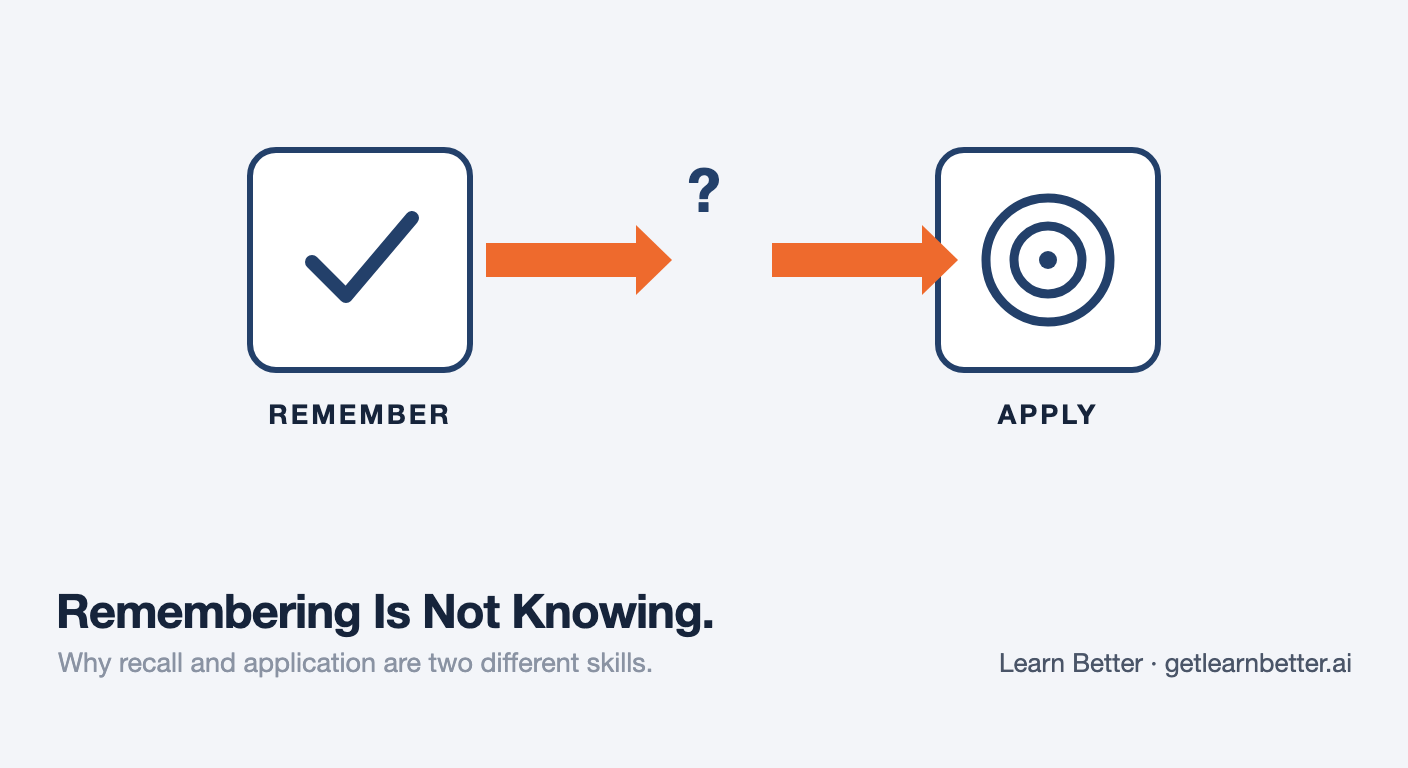
Remembering something well and being able to use it are separate abilities. New 2026 research found that students who practised retrieving a rule from memory recalled it nearly twice as accurately as a control group — and were no better at actually applying it. Strengthening memory does not automatically strengthen the ability to act on what you know, which means most professional learning is measuring the wrong thing.
The problem we think we have
We consume more than ever. So the failure feels obvious: you read something good, and a week later it's gone. Recall looks like the bottleneck, and the entire market has organised around that assumption — highlights, summaries, note systems, flashcards, spaced repetition.
Learning scientist Carl Hendrick recently made a harder argument: even when recall isn't the problem, you're often no better off.
The study
Dutch fourth-graders were taught a set of verb spelling rules. Every child received the same instruction and the same worked examples. Then one group did something extra — three spaced sessions across the week where they closed the book, reconstructed the rules from memory, and checked themselves against the correct version.
That was the only difference between the groups: retrieval practice, added on top of identical teaching.
A week later, both groups took two tests.
| Test | Retrieval-practice group | Control group | Difference |
|---|---|---|---|
| Recall the rules | 88% | 43% | More than double |
| Apply the rules in sentences | 53% | 57% | None (not statistically reliable) |
Retrieval practice made the rules dramatically more memorable. And it moved the ability to use those rules not at all.
Why this happens
The distinction is old. The philosopher Gilbert Ryle separated knowing-that from knowing-how — you can know that a rule exists, state it perfectly, and still not be able to execute it under real conditions. The child who can recite “i before e except after c” and still writes recieve is not suffering a memory failure. The rule is intact. The connection between rule and moment of use was never built.
Cognitive scientist Kenneth Koedinger's work on knowledge components makes the same point mechanically: memory and induction are separable processes. Strengthening one does not automatically strengthen the other. Retrieval practice acts on the first. Application depends on the second.
A recent review by Roelle and colleagues frames retrieval practice as maintenance of meaningful learning rather than its creation. It keeps knowledge available. It does not, on its own, generate the ability to deploy that knowledge in new conditions.
What this doesn't mean
It would be a serious misreading to conclude that retrieval practice doesn't work. It works — it is among the most replicated findings in learning science, and the recall numbers above are exactly what you'd predict.
Hendrick's argument is narrower and more useful: retrieval practice is necessary but not sufficient. It has a job, and application isn't that job.
There's also a threshold effect worth understanding. If a rule isn't fluent — if recalling it still takes conscious effort — that effort consumes working memory needed for the harder task of applying it. So memory work isn't optional; it's a precondition. The sequence matters: memory, then fluency, then application. Skipping the first two doesn't work either.
What this means for professionals
Most professional learning stops at the first rung and reports success. You read the book, you can summarise the framework, you'd recognise it in a list. By the only standard that matters at work — could you use this under conditions nobody prepared you for — none of that has been tested.
Hendrick's principle is the one to take away:
What you practise is what you get.
If your development consists of consuming and reviewing — summaries, highlights, notes, flashcards — you are practising recall. You will get better at recall. You will not get better at the thing you read it for, because that was never what you rehearsed.
Three consequences follow directly:
- The criterial task matters. Practise the thing you actually want to be able to do. If the goal is applying an idea at work, the practice has to involve applying it, not recognising it.
- Sequence matters. Memory first, until it's fluent. Then application. Reversing this or skipping ahead wastes both.
- Dosage matters. Retrieval practice past the point of fluency produces diminishing returns. Time spent making an already-solid fact more solid is time not spent on the harder step.
The question underneath
Some people close this gap without thinking about it. They read something and put it to work on a live problem the same week — the practice happens naturally because the application is right there.
For everyone else, there's a gap between the moment you read something and the moment you'd need it, and nothing happens in between. No return path, no forcing function, no test that ever asks whether you could use it.
That gap isn't a discipline problem. It's a design problem — and almost nothing in the professional learning stack is built to close it.
Frequently Asked Questions
Not on its own. In a 2026 study, students who practised retrieving a set of rules recalled them nearly twice as accurately as a control group — 88% versus 43% — but scored no better at actually applying those rules in sentences (53% versus 57%). Retrieval practice reliably strengthens memory, but strengthening memory does not automatically strengthen the separate ability to use what you know.
The distinction comes from philosopher Gilbert Ryle. Knowing-that is being able to state a fact or rule; knowing-how is being able to execute it under real conditions. You can recite a rule perfectly and still fail to apply it — the rule is intact, but the connection between the rule and the moment of use was never built.
Yes. It's one of the most replicated findings in learning science and it's genuinely necessary — you can't apply an idea you can't reliably recall. It's just not sufficient. The useful framing is a sequence: build memory first, until recall is fluent, then practise application. Skipping the memory step doesn't work either.
Because memory and application are separable processes. Cognitive scientist Kenneth Koedinger's work on knowledge components shows that strengthening memory doesn't automatically strengthen the ability to generalise or apply an idea. Recall keeps knowledge available; using it in a new situation is a different skill that has to be practised directly.
Sources
- Hendrick, C. (2026). “Rethinking Retrieval Practice: Remembering Is Not Knowing.” The Learning Dispatch.
- Ophuis-Cox, F., Catrysse, L., & Camp, G. (2026). Retrieval practice and the transfer of spelling rules. Learning and Instruction.
- Gupta, M., Pan, S.C., & Rickard, T.C. (2026). npj Science of Learning.
- Roelle, J., et al. Review on retrieval practice and meaningful learning.
- Ryle, G. (1949). The Concept of Mind.
- Koedinger, K.R., et al. The Knowledge-Learning-Instruction (KLI) framework.
Start using what you read
LearnBetter is built to close exactly this gap. Once an idea is solid in memory, it comes back as a fresh application challenge — so you practise using it, not just remembering it. Get started free — no credit card required.
Get Started Free