Recognising an idea and actually knowing it are two completely different things. Here's the framework that shows exactly where you are — and how to get to the level that matters under pressure.
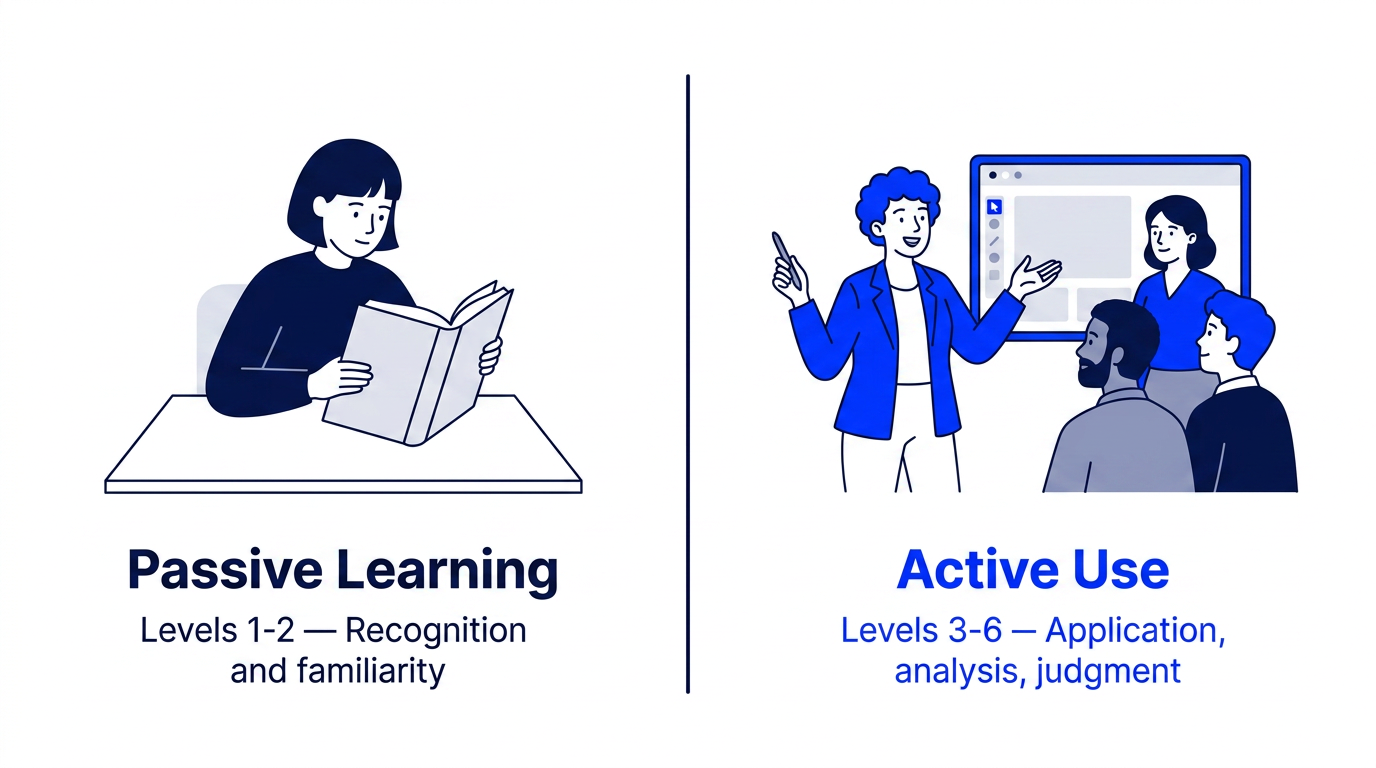
Bloom's taxonomy describes six levels of cognitive learning: Recall, Understanding, Application, Analysis, Evaluation, and Creation. Most professional reading produces Level 1–2. Research by Professor Mary Pat Wenderoth shows that students — and professionals — consistently overestimate the level at which they're operating. Three methods move you from Level 2 to Level 4: asking depth questions after reading, retrieving before re-reading, and explaining without notes.
There's a specific moment most professionals know well.
You read something genuinely useful — a framework, a study, a strategy that felt directly relevant to your work. It clicked. You understood it. You moved on.
Three weeks later, in a meeting where that exact concept would have been valuable, you reach for it. The name is there. The general shape is there. But when someone asks you to apply it, defend it, or explain when it doesn't work — you find you're operating on a memory of understanding, not understanding itself.
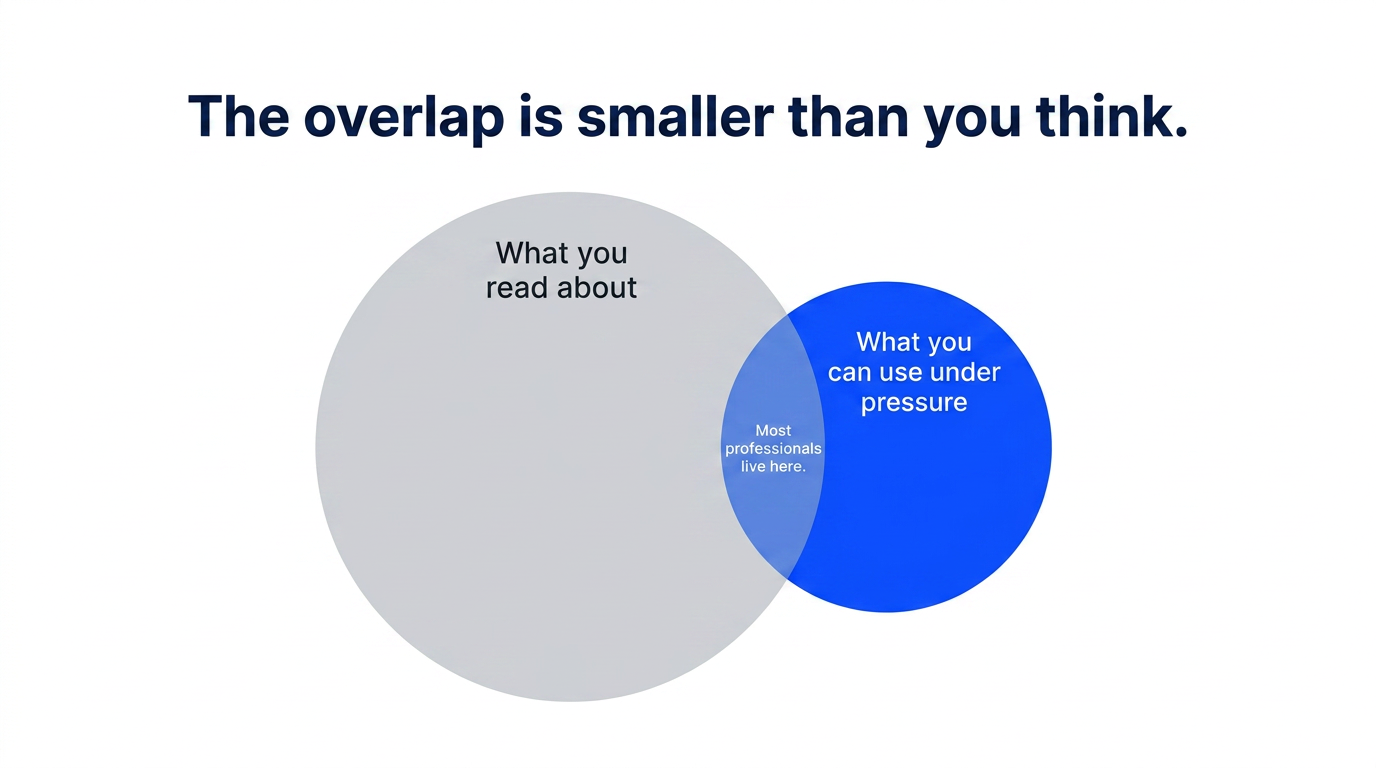
This isn't a memory problem. It's a depth problem.
There are six levels of knowing something. Most professional reading consistently produces the first two. The levels that matter under pressure — the ones that let you apply, analyse, and evaluate in real time — require something different.
The Framework
Benjamin Bloom, an educational psychologist at the University of Chicago, developed a taxonomy of cognitive learning in 1956 that has since become one of the most cited frameworks in learning science. Revised by Krathwohl and Anderson in 2001, it describes six levels of cognitive engagement — each requiring deeper processing than the one before.
Here's what each level actually means — and what it looks like in practice.
Level 1 — Recall
You know the concept exists. You can recognise it when you see it. You'd nod if someone mentioned it in a meeting.
Recall is the most common outcome of professional reading. You finish an article, recognise the ideas, feel informed. That feeling is real. But recall is the shallowest form of knowledge — it's recognition, not usability.
In practice: You know what "jobs to be done" means. You've heard of spaced repetition. You know the difference between precision and recall in machine learning. You couldn't define any of them from scratch without prompting.
Level 2 — Understanding
You can explain the concept in your own words. You can describe the mechanism, not just the label. You can answer "what does this mean?" for someone who hasn't read what you've read.
Understanding feels like genuine knowledge — and compared to recall, it is. But it's still passive. You've absorbed the idea well enough to paraphrase it. You haven't yet tested whether you can do anything with it.
In practice: You can explain why spaced retrieval works — that the brain reconsolidates memories more robustly when retrieved after some forgetting has set in. You understand the logic. You haven't yet changed how you study anything.
Level 3 — Application
You've used the concept in a real situation. Not in an exercise, not hypothetically — in actual work, with actual stakes.
Application is where passive knowledge becomes active. It's also where the gap between what you thought you understood and what you actually understood becomes visible. A concept that seemed clear on paper often reveals complexity the moment you try to use it.
In practice: You've used jobs-to-be-done to structure a customer interview — not just read about it. You've applied a prioritisation matrix to a real roadmap decision. You've used technical debt as an argument to a sceptical engineering lead.
Level 4 — Analysis
You can break down the concept — its components, underlying assumptions, and the conditions under which it applies and doesn't apply.
Analysis is what separates people who can use a framework from people who know how to use it well. It requires understanding not just what a concept does but why it works — and therefore when it won't.
In practice: You understand that spaced repetition produces the strongest gains when retrieval is effortful — so passive review at spaced intervals doesn't produce the same effect. You know that jobs-to-be-done works best for understanding existing behaviours and poorly for understanding latent needs. You can diagnose why a framework failed in a situation, not just apply it when it succeeds.
Level 5 — Evaluation
You can judge the quality, validity, or appropriateness of something — not just apply a concept but assess whether someone else's application of it is correct, sound, or appropriate for the context.
Evaluation is what makes someone genuinely senior in their domain. It's the level where you can look at a strategy, an output, an argument, or a decision — and tell the difference between structurally sound and plausible-sounding. That judgment requires deep retained knowledge.
In practice: You sit in a strategy review where someone invokes first-mover advantage and push back — because you know the conditions under which it's real versus where being second wins. You review an AI-generated market sizing model and catch that the TAM calculation rests on an assumption with no basis. You've developed taste, not just knowledge.
Level 6 — Creation
You can generate something new using the concept as a building block. Not apply an existing framework but synthesise, design, or build something that didn't exist before — using deep understanding as the raw material.
Creation is rare in professional work, but it's where the most distinctive contributions happen. It requires such thorough understanding of a domain that you can recombine its elements in novel ways.
In practice: You've synthesised a prioritisation approach from three existing methods that none of them alone handled well. You've designed a framework your team now uses for decisions you used to make inconsistently. You've built something others can use.
Why Most Professionals Stop at Level 2
Professor Mary Pat Wenderoth at the University of Washington ran an experiment with her biology students. After every test, she gave them an answer key showing what a correct response looked like at each level of the taxonomy — what recall looked like, what understanding looked like, what analysis looked like. Students had to identify where their own answers actually fell.
The pattern was consistent. Students who felt they understood the material discovered they were operating at recall. They had the right words, could recognise the concept — but when asked to apply or analyse it, the answer wasn't there. Wenderoth called it "the illusion of knowing."
The same gap exists in professional work. Most professionals feel they're at Level 3 or 4. The evidence suggests they're usually at Level 2.
This isn't a failure of attention or intelligence. It's a structural feature of how most professional learning happens. Reading produces smooth, fluent processing — which the brain interprets as understanding. But fluency and usability are not the same thing. The brain is very good at generating the feeling of understanding without building the structure that makes knowledge usable under pressure.

What the Research Shows About Why the Gap Exists
Three converging lines of research explain why reading produces Level 2 knowledge so reliably — and why it so rarely goes further.
The fluency illusion. Robert Bjork at UCLA has shown that performance during learning is a poor predictor of long-term retention and transfer. Well-written material produces smooth, fluent reading — which feels like deep understanding. But fluency is measuring ease of processing, not depth of encoding.
The generation effect. Studies by Slamecka and Graf (1978), replicated extensively since, show that information you generate yourself — through retrieval, application, explanation — is retained significantly better than information you passively receive. Most professional reading is passive receipt.
Transfer-appropriate processing. Research in cognitive psychology shows that how you learn something determines when you can use it. If you learn a framework by reading about it, you're best positioned to recognise it while reading. If you want to use it in a meeting, you needed to practise using it in meeting-like conditions. Most professional learning doesn't match the conditions of use.
Together these explain why reading reliably produces Level 2 knowledge: it's fluent, passive, and practised in the wrong context.
How to Move From Level 2 to Level 4
The gap isn't closed by reading more carefully. It's closed by changing what you do after reading.
Ask depth questions, not comprehension questions.
Most people assess their own learning by asking: "Did I understand this?" That question returns yes when you could follow the argument. It doesn't test usability.
Replace it with two questions after every piece of content worth retaining:
"Where specifically would I apply this in my current work?" — This forces Level 3. If you can't name a specific situation, you're at Level 2.
"When would this be the wrong approach?" — This forces Level 4. If you can only describe when something works, you don't yet understand it analytically.
These two questions, asked consistently after reading, produce significantly deeper encoding than comprehension-checking alone.
Retrieve before you return.
When you go back to material — after 48 hours, after a week — don't re-read first. Reconstruct what you remember from memory. Then check the source for what you missed.
Retrieval at a higher cognitive level builds the pathways for higher-level recall. If you always re-read rather than retrieve, you stay at Level 1–2 regardless of how many times you return to the material.
Explain it once without notes.
Teaching is the highest-demand form of retrieval. Explaining something to a colleague without notes, under the pressure of their questions, surfaces gaps faster than any self-assessment. The questions they ask reveal exactly where your understanding breaks down. Those breakdowns are where real depth gets built.
How Learn Better Approaches Depth of Learning
Most tools optimise for coverage — helping you process more content. Learn Better is designed for depth.
When you add an article to Learn Better, it extracts the key concepts and generates retrieval questions across all six Bloom's levels. Rather than only asking "What is X?" (Level 1), it generates questions like "In what situation would you apply this?" (Level 3) and "What assumptions does this rely on — and when would those assumptions break?" (Level 4).
The questions are scheduled using one of the most accurate spaced repetition algorithms used in the industry at the optimal interval for reconsolidation. Over time, the system builds your knowledge of each concept at the levels that matter under pressure — not just the level that feels satisfying in the moment of reading.
What to Try This Week
Pick one concept you've read about recently that you'd say you know.
Ask yourself these two questions without looking anything up:
Name a specific situation in your current work where you'd apply this.
Name a condition under which this would be the wrong approach.
If you can answer both clearly, you're at Level 4. If you can answer the first but not the second, you're at Level 3. If you can't answer either concretely, you're at Level 2 — regardless of how well you understood it when you read it.
The goal isn't to feel bad about where you are. It's to know precisely — so you know exactly what to practise next.
Frequently Asked Questions
Bloom's taxonomy is a framework for classifying cognitive learning developed by Benjamin Bloom in 1956 and revised in 2001. It describes six levels of knowing: Recall, Understanding, Application, Analysis, Evaluation, and Creation. Each level requires deeper cognitive processing than the one before and produces more durable, usable knowledge.
Three reasons. First, reading produces fluent processing which the brain mistakes for understanding (the fluency illusion). Second, reading is passive — information received passively is retained less well than information generated actively (the generation effect). Third, reading conditions don't match the conditions of use, so knowledge learned through reading is most accessible while reading, not while working.
Level 2 (Understanding) means you can explain a concept in your own words. Level 3 (Application) means you've actually used the concept in a real situation with real stakes. The gap between them is the gap between paraphrasing and doing — and it's larger than most professionals expect until they try to cross it.
Coined by Professor Mary Pat Wenderoth, the illusion of knowing describes the gap between feeling like you understand something and actually being able to use it. It arises because fluent reading generates a sensation of comprehension that doesn't reliably predict whether knowledge is usable under pressure.
While originally developed for educational settings, Bloom's taxonomy describes how knowledge develops regardless of context. For professionals, the levels map onto the difference between knowing about a framework (Level 1–2) and being able to apply it in a client meeting (Level 3), diagnose why it's failing (Level 4), evaluate whether a colleague is using it correctly (Level 5), or synthesise something new from it (Level 6).
Two questions reliably force deeper cognitive processing after reading: "Where specifically would I apply this in my current work?" (forces Level 3 Application) and "When would this be the wrong approach?" (forces Level 4 Analysis). Asking both after every piece of content worth retaining produces significantly deeper encoding than comprehension-checking alone.
Retrieval practice — reconstructing what you know from memory before re-reading — forces you to operate at the level you're actually at rather than the level you feel you're at. Retrieving at a higher cognitive level (trying to explain when a concept applies vs simply recalling its definition) builds pathways for higher-level recall over time.
Sources
- Bloom, B.S. (1956). Taxonomy of Educational Objectives. David McKay Company.
- Krathwohl, D.R. & Anderson, L.W. (2001). A Taxonomy for Learning, Teaching, and Assessing.
- Bjork, R.A. & Bjork, E.L. (1992). A New Theory of Disuse. In A. Healy, S. Kosslyn, & R. Shiffrin (Eds.), From Learning Processes to Cognitive Processes.
- Slamecka, N.J. & Graf, P. (1978). The Generation Effect: Delineation of a Phenomenon. Journal of Experimental Psychology: Human Learning and Memory, 4(6), 592–604.
- Brown, P.C., Roediger, H.L., & McDaniel, M.A. (2014). Make It Stick: The Science of Successful Learning. Harvard University Press.
Start using what you read
LearnBetter generates retrieval questions at every level of Bloom's taxonomy — automatically, from articles you already read. Get started free — no credit card required.