Spaced repetition is the most famous idea in learning science. It's also the smaller one. Here's what sits above it — and why it's the part that actually changes how you work.
Spaced repetition is a scheduler: it brings each idea back at expanding intervals until you can reliably recall it. Spaced learning is the broader principle it comes from — that any practice, including practice at using an idea, becomes more durable and more flexible when it's distributed over time. The research is clear that spacing doesn't only strengthen memory; it improves your ability to generalize and transfer what you know to new situations. Remembering a concept is the floor. Being able to use it when it counts is the ceiling — and that takes spaced application, not just spaced review.
You can recite the framework. You've read the book twice. And in the meeting where it would actually have helped, none of it showed up.
That gap — between knowing something and being able to use it — is the whole game for professionals. And most advice about "learning better" quietly ignores it. The internet's favourite technique, spaced repetition, is built almost entirely around the first half: remembering. It's a genuinely powerful tool. But it's a floor, not a ceiling, and the two words people use for it — spaced repetition and spaced learning — are not the same thing.
Spaced repetition asks, "Do you still remember this?" Spaced learning asks, "Can you use this here?"
Two terms that get used interchangeably — and shouldn't be
They're related, which is why they blur together. But they operate at different levels.
Spaced repetition is a specific technique. It's a scheduler: it takes an individual fact or idea and brings it back at expanding intervals — a day, then a few days, then a week, then a month — timed to just before you'd forget it, so each retrieval resets the forgetting curve and makes the memory more durable than the last. It's the engine inside every flashcard app. And on its own, it optimizes for one thing: reliable recall.
Spaced learning — also called the spacing effect, or distributed practice — is the underlying principle spaced repetition is one application of. It says something broader and more useful: any kind of practice produces stronger, more flexible learning when it's spread across time instead of massed into one sitting. Not just reviewing facts — practising skills, working problems, applying ideas. The spacing is the active ingredient. What you space is up to you.
Put simply: spaced repetition is the "space out your reviews" rule. Spaced learning is the "space out your practice" rule — and practice can climb far past remembering.
The science: spacing helps you transfer, not just remember
The retention benefit of spacing is one of the most replicated findings in psychology. In a large study of the spacing effect, Cepeda and colleagues found that reviewing at the right interval, rather than back-to-back, produced a substantial jump in long-term recall.
Here's the part that rarely makes it into the flashcard blog posts. Spacing doesn't just help you hold onto information — it helps you generalize it.
Kornell and Bjork ran a now-classic study where people learned to recognize the styles of different painters. One group studied each artist's works all together (massed); the other studied them spread out and interleaved with other artists (spaced). Then everyone was tested on paintings they had never seen. The spaced group was reliably better at identifying the artist of a brand-new work — not because they'd memorized more paintings, but because distributed practice helped them extract the underlying pattern and apply it to novel cases. The researchers titled the paper with the question they'd expected to confirm — is spacing the enemy of induction? — and found the opposite. Spacing was its friend.
Rohrer and Taylor found the same shape in a very different domain: mathematics. When practice problems were distributed and mixed rather than blocked together, students performed markedly better on later tests — including on problem types they hadn't drilled. Spacing (and its cousin, interleaving) didn't just make the practice stick; it made the skill transferable.
Distributed practice doesn't only make memories last longer. It makes knowledge more usable in situations you've never seen before.
Robert Bjork calls conditions like these "desirable difficulties" — practice that feels harder in the moment (spacing, retrieving, mixing) but produces deeper, more flexible learning. And it comes with a warning that matters here: Bjork and Soderstrom draw a sharp line between performance (how well you can do something right now, during study) and learning (whether it's still there, and usable, later). Massed cramming spikes performance and fakes learning. Spacing does the reverse: it can feel slower and shakier while you're doing it, then quietly wins the only test that matters — the one weeks later, in the real world.
Why remembering is the floor, not the ceiling
For a student cramming for an exam, recall might genuinely be the goal. For a professional, it almost never is. Nobody is going to quiz you on the definition of a concept. They're going to hand you a messy, half-formed situation and expect you to reach for the right idea and apply it — often one you first read months ago.
That's why remembering is the floor. It's necessary — you can't use an idea you can't retrieve — but it's nowhere near sufficient. Being able to state a framework is a different skill from being able to recognize, in the moment, that this is the situation the framework is for. The first is recall. The second is transfer. And transfer is the actual product of professional learning.
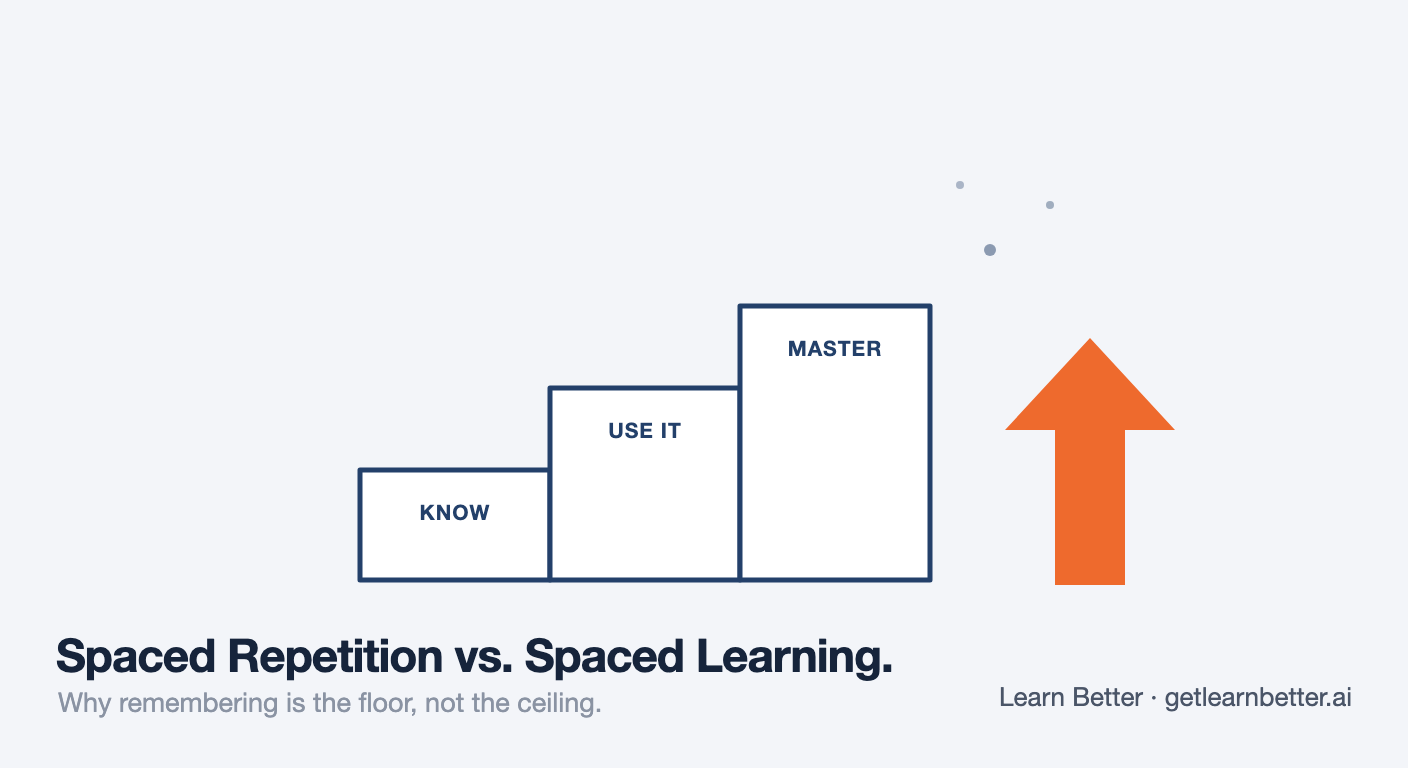
This maps cleanly onto how learning scientists describe the climb from knowing to doing — from simply recalling a fact, up through applying it, to using it fluently in new contexts. A tool built only for the bottom rung will make you excellent at the thing that matters least.
A flashcard app makes you reliable at remembering. It was never designed to make you good at using what you remember.
What spaced learning looks like in practice
If spacing is the active ingredient and application is the goal, the move is straightforward to describe and rare to actually do: space your application practice, not just your reviews.
Concretely, that means returning to an idea over time and, each time, being asked to do something a little harder with it:
First, secure recall. Can you reconstruct the idea from memory without looking? Until that's reliable, everything above it is guesswork.
Then, space the application. Days later, don't just re-test the definition — put the idea into a new scenario. "Here's a situation. Does this concept apply, and how?"
Vary and escalate. Each return, change the context and raise the difficulty — a different domain, a trade-off, an edge case where the idea half-applies. Varied, progressively harder practice is what builds transfer.
Done by hand, this is a lot to manage: you'd have to track which ideas are due, remember what you've already been asked, and keep inventing fresh, progressively harder scenarios for each one — forever. It's exactly the kind of bookkeeping that makes people quit after two weeks.
How LearnBetter runs both loops
LearnBetter is built around this distinction. It doesn't just run spaced repetition — it runs spaced learning.
When you add an article or video, it pulls out the ideas worth keeping and starts two loops on each one. The first is classic spaced repetition: retrieval questions, scheduled at expanding intervals, to make the idea reliable — the Know level. The second is spaced application: once recall is solid, the idea comes back as a fresh scenario each time — a judgment call, a trade-off, an applied "what would you do here?" — drawn from 55 question types purpose-built to climb from remembering to using. That's the Use and Master levels.
And because the two are genuinely different skills, LearnBetter measures them separately: how well you remember each idea, and — on its own track — how well you can use it. You can watch recall harden into applied skill, idea by idea, instead of guessing whether reading something once did anything at all.
Take one idea you read this month and genuinely rate yourself on two separate questions. One: can you reconstruct it from memory right now? Two: could you correctly apply it to a situation you've never seen? Most people find a wide gap between the two answers — and that gap, not your memory, is what actually holds back how much your reading changes your work.
Spaced repetition earns you the first answer. It's real, it's powerful, and it's where most tools stop. But the second answer is the one your job is actually testing — and closing that gap takes spaced practice at using the idea, not just holding onto it.
Remembering is the entry fee. Using it is the point.
Frequently Asked Questions
Spaced repetition is the narrower tool: a scheduler that brings each idea back at expanding intervals until recall is reliable. On its own, it's mostly about remembering. Spaced learning is the broader principle from cognitive science: any practice — including practice at applying an idea, not just recalling it — builds more durable and more flexible knowledge when it's distributed over time.
Both. Beyond strengthening retention, spacing improves the ability to generalize and transfer. Kornell and Bjork found that spacing study across examples helped people apply an underlying pattern to new cases they had never seen, and Rohrer and Taylor found that distributing and mixing practice problems improved performance on novel problems later. Spacing doesn't just make memories last — it makes knowledge more usable.
It's necessary but not sufficient. Reliable recall is the foundation — you can't apply an idea you can't remember. But recall is the floor, not the ceiling. Being able to state a framework is not the same as being able to use it in a situation you've never faced. That requires spaced practice at applying the idea, not just retrieving it.
Transfer is the ability to take something you learned in one context and use it in a new, unfamiliar one — the difference between recognizing a concept on a quiz and reaching for it in a real meeting or decision. Transfer is the actual goal of professional learning, and research shows it's supported by distributed, varied, progressively harder practice rather than massed repetition.
LearnBetter runs both loops. Spaced repetition makes an idea reliable (the Know level). Then spaced application practice — a fresh scenario each time an idea returns, drawn from 55 question types that climb from recall to real application — turns that reliable knowledge into skill (Use, then Master). It measures how well you remember each idea and, separately, how well you can use it.
Sources
- Cepeda, N.J., Vul, E., Rohrer, D., Wixted, J.T., & Pashler, H. (2008). Spacing Effects in Learning: A Temporal Ridgeline of Optimal Retention. Psychological Science, 19(11), 1095–1102.
- Kornell, N., & Bjork, R.A. (2008). Learning Concepts and Categories: Is Spacing the "Enemy of Induction"? Psychological Science, 19(6), 585–592.
- Rohrer, D., & Taylor, K. (2007). The Shuffling of Mathematics Problems Improves Learning. Instructional Science, 35, 481–498.
- Soderstrom, N.C., & Bjork, R.A. (2015). Learning Versus Performance: An Integrative Review. Perspectives on Psychological Science, 10(2), 176–199.
- Brown, P.C., Roediger, H.L., & McDaniel, M.A. (2014). Make It Stick: The Science of Successful Learning. Harvard University Press.
Start using what you read
LearnBetter runs both loops — spaced repetition to make ideas stick, spaced application to make them transfer. Get started free — no credit card required.