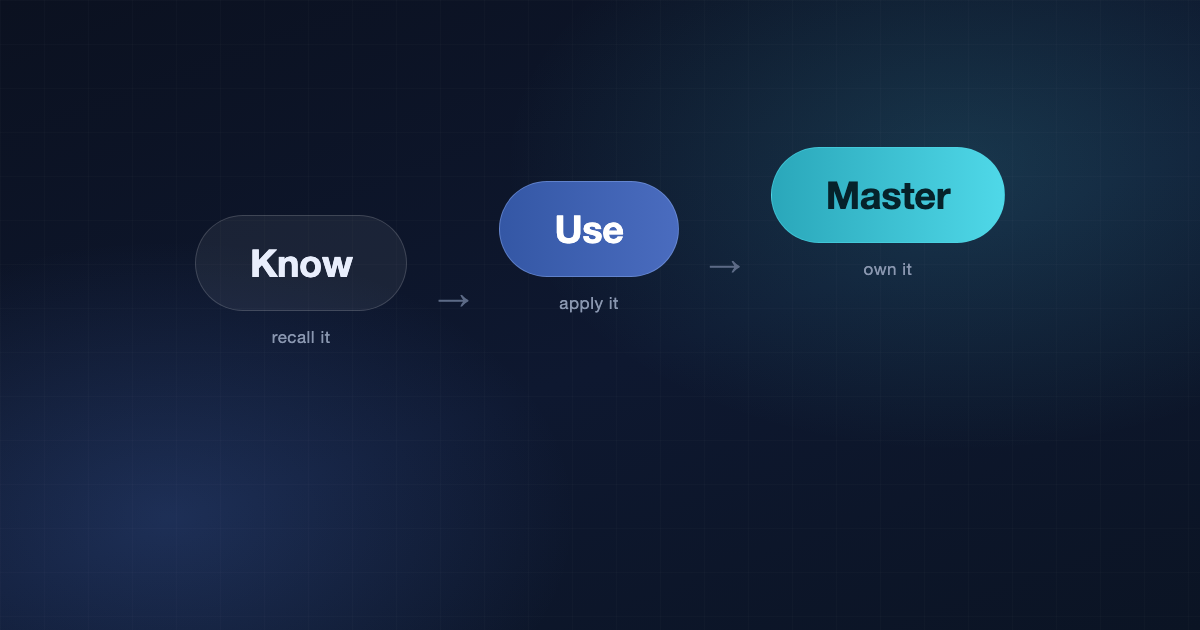
Most people try to learn better by doing more — more reading, more highlighting, more courses. But how much you learn depends far more on method than on hours. A handful of techniques, all well-established in cognitive science, reliably turn what you read into knowledge you can recall and use. Here they are, and how to actually apply them.
The frustrating part of learning as an adult isn't a lack of material. It's that so little of it sticks. You read a sharp article, nod along, feel like you got it — and a week later almost nothing is left. That's not a discipline problem. It's a method problem, and it has a fix.
First, why most learning doesn't stick
Reading, highlighting, and re-reading all share one weakness: they're passive. The information flows past smoothly, which feels like understanding. But smooth processing in the moment is a poor predictor of what you'll be able to recall later — a trap researchers call the fluency illusion. The method that feels most productive is often the one working least.
Left alone, new information decays fast. Without reinforcement, people forget a large share of what they read within a day or two — the pattern first mapped by Hermann Ebbinghaus as the forgetting curve. Learning better means working with how memory actually operates instead of against it.
Learning better isn't about spending more time. It's about spending it on the things that feel harder and work better.
The techniques below are what learning scientists call “desirable difficulties” — practices that feel more effortful than re-reading, and precisely because of that effort, produce far stronger, more usable knowledge.
The six habits that actually work
1. Test yourself before you re-read
The most reliable upgrade you can make is to swap re-reading for retrieval practice: after reading something, close it and try to reconstruct the key ideas from memory. The act of pulling information out — not putting it back in — is what strengthens it. In classic experiments, students who tested themselves once remembered dramatically more a week later than students who re-studied the same material, an effect so consistent it has its own name, the testing effect.
In practice: after an article, spend 60 seconds writing down what mattered without looking. The gaps you find are the point — they show you what didn't stick yet.
2. Space it out
The same total time produces very different results depending on how you distribute it. One long session (cramming) gets you through a test tomorrow; several short sessions spread over days build memory that lasts. A large review by Cepeda and colleagues found that spaced repetition reliably beats massed practice for long-term recall — and the longer you need to remember something, the bigger the advantage of spacing.
In practice: revisit an important idea a day later, then a few days after that, then a week or two later. Each well-timed return, done just as you're starting to forget, resets the forgetting curve and pushes the memory further out.
3. Make it a little harder on purpose
Mixing topics rather than blocking them (interleaving), and forcing yourself to retrieve before you feel ready, both feel worse and work better. Struggling to recall — even briefly — signals your brain that this is worth keeping. Comfort is the enemy here: if practice feels effortless, it's probably not changing much.
4. Go past recall — put it to use
Here's the step most people miss: remembering something and being able to use it are different skills, and practicing one doesn't automatically build the other. You can recite a framework perfectly and still freeze when it's time to apply it in a real decision.
So practice using it. After you learn an idea, ask two questions: Where specifically would I apply this in my own work? and When would this be the wrong approach? Those questions push you up the levels of understanding — from recall toward genuine application and judgment (the climb described in the six levels of learning).
Recall is the floor, not the ceiling. The goal isn't to remember an idea — it's to have it available when the moment calls for it.
5. Explain it in your own words
If you can't explain something simply, you don't yet understand it. Putting an idea into your own words — teaching it to a colleague, writing a two-line summary from memory, connecting it to something you already know — forces you to organize and encode it far more deeply than re-reading ever could. This is elaboration, and it turns isolated facts into a connected structure you can actually retrieve.
6. Learn less, on purpose
Trying to keep everything guarantees you keep almost nothing. Learning better means being ruthless about what deserves your attention: the two or three ideas from an article that are genuinely worth owning, not every sentence you highlighted. Fewer ideas, practiced properly, beat a mountain of notes you'll never revisit.
What feels productive vs. what works
| Feels productive | Actually builds learning |
|---|---|
| Re-reading & highlighting | Recalling from memory |
| One long cram session | Short sessions spread over time |
| Studying one topic in a block | Mixing topics (interleaving) |
| Recognizing the answer | Producing & applying it |
| Collecting more notes | Keeping a few ideas well |
Put it together: a simple weekly loop
You don't need a system with twelve steps. You need a loop you'll actually run:
Read → Recall → Return → Apply. Read the thing. Close it and recall the two or three ideas worth keeping. Return to them a day and a week later. And the first chance you get, use one of them on something real. That loop — not more reading — is what learning better looks like in practice.
The hard part isn't knowing this. It's doing it consistently, at the right moments, without it becoming another chore. That's exactly the gap LearnBetter is built to close.
Frequently Asked Questions
The single most effective change is to replace re-reading with retrieval practice — testing yourself on the material from memory instead of reviewing it. Decades of research find that recalling information strengthens memory far more than re-studying it, typically producing 20–50% better long-term retention. Add spacing (returning at increasing intervals) and application (using the idea on a real problem) and you have the core of learning better.
Because reading is passive. Without effortful retrieval, memories decay along the forgetting curve — people lose a large share of new information within a day or two. Highlighting and re-reading feel productive but mostly create a fluency illusion: the material feels familiar without being retrievable later. Testing yourself and spacing your review are what convert reading into durable memory.
Spread it out. Distributed practice — the same total time split across several sessions — produces substantially better long-term retention than one massed session (cramming). A large review by Cepeda and colleagues found spacing reliably improves recall, and the benefit grows the longer you need to remember something.
Remembering and using are separate skills. To use what you learn, you have to practice using it: apply the idea to a real situation, ask where and when it would apply, and explain it in your own words. Recall gets the idea into memory; application is what makes it available when you need it at work.
Sources
- Roediger, H.L., & Karpicke, J.D. (2006). Test-Enhanced Learning: Taking Memory Tests Improves Long-Term Retention. Psychological Science, 17(3), 249–255.
- Cepeda, N.J., Pashler, H., Vul, E., Wixted, J.T., & Rohrer, D. (2006). Distributed Practice in Verbal Recall Tasks: A Review and Quantitative Synthesis. Psychological Bulletin, 132(3), 354–380.
- Dunlosky, J., Rawson, K.A., Marsh, E.J., Nathan, M.J., & Willingham, D.T. (2013). Improving Students' Learning With Effective Learning Techniques. Psychological Science in the Public Interest, 14(1), 4–58.
- Kornell, N., & Bjork, R.A. (2008). Learning Concepts and Categories: Is Spacing the “Enemy of Induction”? Psychological Science, 19(6), 585–592.
Learning better, on autopilot
LearnBetter runs the loop for you — it pulls the ideas worth keeping from anything you read, tests you on them at the right moments, and pushes you from recall to real application. Get started free — no credit card required.
Get Started Free