What Is Active Recall?
Active recall is pulling information out of your memory, rather than putting it back in. You close the book and ask yourself what it said. You answer a question before looking at the answer. You write down everything you remember about a topic on a blank page.
Passive review is the opposite. Re-reading, highlighting, skimming your notes, watching a summary video. The information flows towards you. Nothing is asked of you.
Researchers usually call active recall retrieval practice, or the testing effect. The terms mean the same thing. It is one of only two techniques that a large 2013 review of ten popular study methods rated as highly useful. The other was spacing your practice over time.
Re-reading asks: does this look familiar? Active recall asks: can I produce it? Only the second question builds memory.
Why Active Recall Works
Every time you successfully pull something out of memory, the path back to it gets stronger. Retrieval is not just a way of checking what you know. It changes what you know.
Two findings explain why.
Effort is the point
In 2009, Mary Pyc and Katherine Rawson tested whether harder recall leads to stronger memory. It did. Retrieval that took more effort, but still succeeded, produced better long-term memory than easy retrieval. Robert Bjork calls this a desirable difficulty: a struggle that feels like you are doing badly while you are actually learning more.
This is why active recall feels worse than re-reading. Re-reading is smooth. Recall is halting and uncomfortable. That discomfort is the work being done.
Producing beats seeing
Psychologists have known since 1978 that people remember words they generate themselves better than words they simply read. It is called the generation effect. When you produce the answer, you build it. When you read it, you only recognise it.
The Mistake That Cancels the Benefit: Recognition Disguised as Recall
Most people who say they use active recall are not quite doing it. The most common version looks like this: read the front of a flashcard, think "oh yes, I know this", flip it, see the answer, feel satisfied, move on.
That is recognition. You never produced the answer. You saw it, and it felt familiar. Familiarity is exactly the feeling that makes re-reading feel productive when it isn't.
The test is simple. Did you commit to a specific answer before you checked? Out loud, in writing, or at least as a complete sentence in your head. If not, it was not recall.
7 Active Recall Techniques
These are ordered roughly from least to most effort. All of them work on articles, books, courses and reports, not just exam material.
1. The blank page
After reading, take a blank page and write down everything you remember. No headings from the source, no peeking. When you run dry, then open the source and look at what you missed. The gaps are your study list.
2. Read with a question first
Before you start a chapter, turn its heading into a question. "Pricing strategy" becomes "what are the main ways to set a price, and when does each one fail?" You now read to answer something, and at the end you have something to answer from memory.
3. The closed-book summary
Close the source and summarise it in three sentences. This is different from summarising while looking, which is mostly copying. The closed-book version forces you to decide what mattered.
4. Write your own questions
As you read, write questions in the margin or in a note — not answers. Come back later and answer them without the text. Good questions ask why and when, not just what. "What is the forgetting curve?" is fine. "Why would two people forget the same article at different rates?" is better.
5. Explain it out loud
Explain the idea to someone else, or to an empty room, as if they had never heard of it. You will hit the points where your understanding is thin almost immediately. This is the heart of the Feynman technique.
6. Predict, then check
Before turning the page or reading the conclusion, predict what comes next. What will the author recommend? What will the study find? Being wrong and then corrected is one of the strongest ways to remember the right answer.
7. Recall before you re-read
When you return to something you read last week, do not open it straight away. Spend a minute recalling what it said first. Then open it. This turns every re-read into a recall session for the price of one extra minute.
Active Recall vs Passive Review
The two can take the same amount of time. They produce very different results a week later.
- Passive review feels fluent, gives a strong sense of progress, and fades quickly.
- Active recall feels slow, shows you how much you have forgotten, and lasts.
The cruel part is that the feeling of learning points the wrong way. People reliably judge re-reading as more effective, even after a test shows the opposite. We wrote more on this in the illusion of learning.
Pair It With Spacing
Active recall answers how to review. Spacing answers when. Recalling something once, right after reading it, helps. Recalling it again a few days later, when it is harder to reach, helps much more. That is the idea behind spaced repetition: the schedule, with recall as the method at each step.
Recall Is the Floor, Not the Ceiling
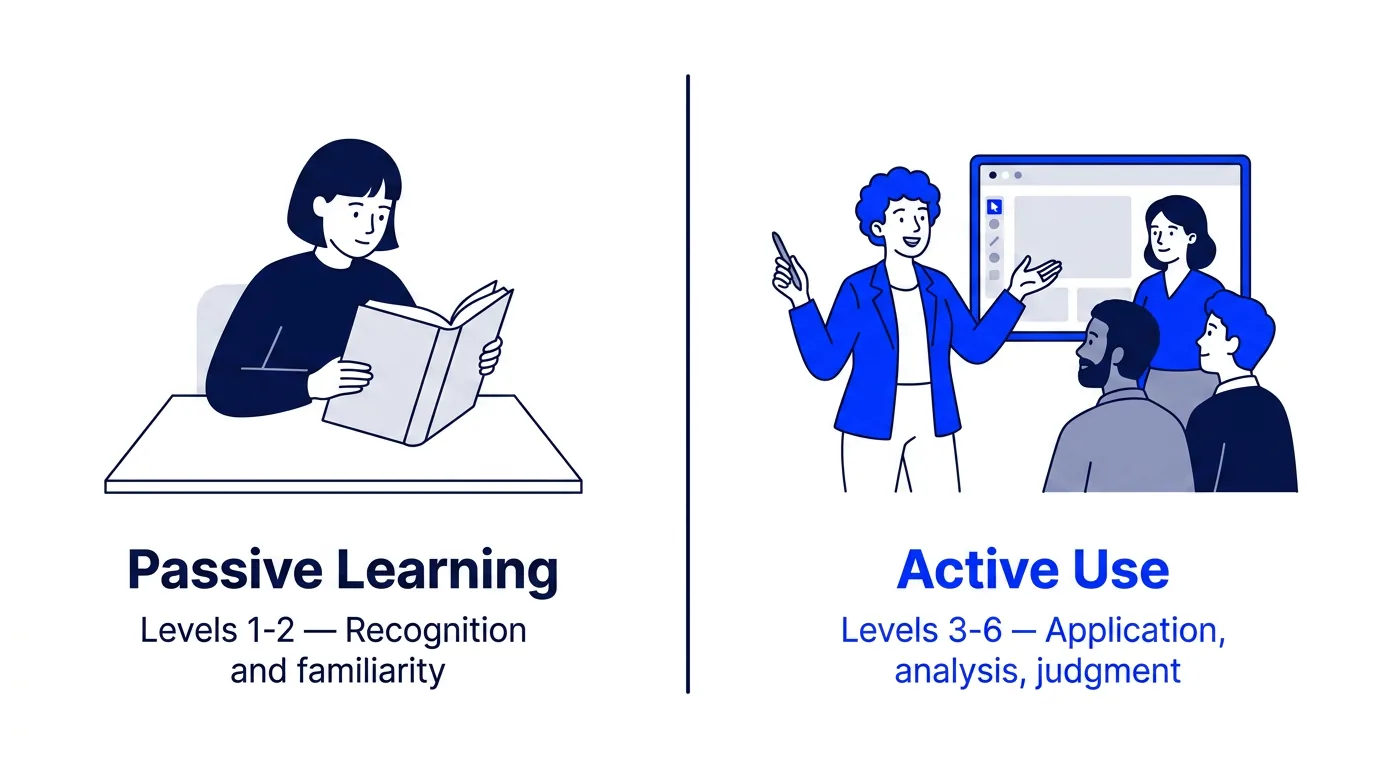
Active recall makes sure you can produce an idea when asked. That matters. But being able to state an idea is not the same as being able to use it in a situation you have not seen before. Research has found that retrieval practice can double recall of a rule while doing nothing for applying it. We covered that in remembering is not knowing.
So use recall to make ideas stick. Then practise using them: deciding which idea fits a new case, spotting where one breaks, comparing two approaches. That is where reading becomes skill.
Recall gets the idea into your head. Application gets it into your work.
How LearnBetter Does Active Recall for You
Every technique above has the same cost: you have to stop and build the recall yourself. Write the questions, cover the page, remember to come back. Most people manage it for a week.
LearnBetter does that part. You add what you are reading — an article link, a PDF or ebook, a Word document, a YouTube video or pasted text. It picks out the key concepts and turns each one into short questions you answer from memory, before you see anything. That is real recall, not recognition: you commit to an answer, then find out.
It also avoids the trap this article warns about. The questions don't stop at "what is it?". They move on to explaining why, choosing which idea fits a new situation, and spotting where one breaks — so you practise using what you read, not just stating it. Each concept then comes back on a schedule, just before you would forget it.
This article is part of our guide to how to learn better — six science-backed habits for remembering and using what you read.
Frequently Asked Questions
Active recall is retrieving information from memory without looking at the source — answering a question, writing down what you remember, or explaining an idea from scratch. It is the same thing researchers call retrieval practice or the testing effect.
Yes. Active recall is the everyday name; retrieval practice and the testing effect are the research names. All three describe strengthening memory by producing information rather than re-reading it.
Because it is harder, and that is why it works. Effortful retrieval that succeeds builds stronger memory than easy review. Re-reading feels smooth because the material is in front of you, which creates familiarity without building recall.
Only if you commit to an answer before you flip the card. Glancing at the front, feeling that you know it, and flipping is recognition, not recall. Say or write the answer first, then check.
Right after reading, then again a few days later, then at longer gaps. Combining recall with spacing over time gives far better long-term retention than recalling once.
The blank page (write everything you remember), turning headings into questions before reading, closed-book summaries, writing your own questions, explaining out loud, predicting before checking, and recalling before re-reading.
It helps you remember, which is the foundation. But research shows recall and application are separate skills. To use an idea in new situations, you also need practice applying it, not just stating it.
Sources
- Roediger, H.L. & Karpicke, J.D. (2006). Test-enhanced learning: Taking memory tests improves long-term retention. Psychological Science, 17(3), 249–255.
- Karpicke, J.D. & Blunt, J.R. (2011). Retrieval practice produces more learning than elaborative studying with concept mapping. Science, 331(6018), 772–775.
- Dunlosky, J., Rawson, K.A., Marsh, E.J., Nathan, M.J., & Willingham, D.T. (2013). Improving students' learning with effective learning techniques. Psychological Science in the Public Interest, 14(1), 4–58.
- Pyc, M.A. & Rawson, K.A. (2009). Testing the retrieval effort hypothesis: Does greater difficulty correctly recalling information lead to higher levels of memory? Journal of Memory and Language, 60(4), 437–447.
- Slamecka, N.J. & Graf, P. (1978). The generation effect: Delineation of a phenomenon. Journal of Experimental Psychology: Human Learning and Memory, 4(6), 592–604.
- Bjork, R.A. (1994). Memory and metamemory considerations in the training of human beings. In J. Metcalfe & A. Shimamura (Eds.), Metacognition: Knowing about Knowing (pp. 185–205). MIT Press.
- Brown, P.C., Roediger, H.L., & McDaniel, M.A. (2014). Make It Stick: The Science of Successful Learning. Harvard University Press.
Active recall, built in
LearnBetter turns the concepts in what you read into short recall and application questions, and brings them back before you forget. Free to start.
Get Started Free