Why Information Doesn't Stick
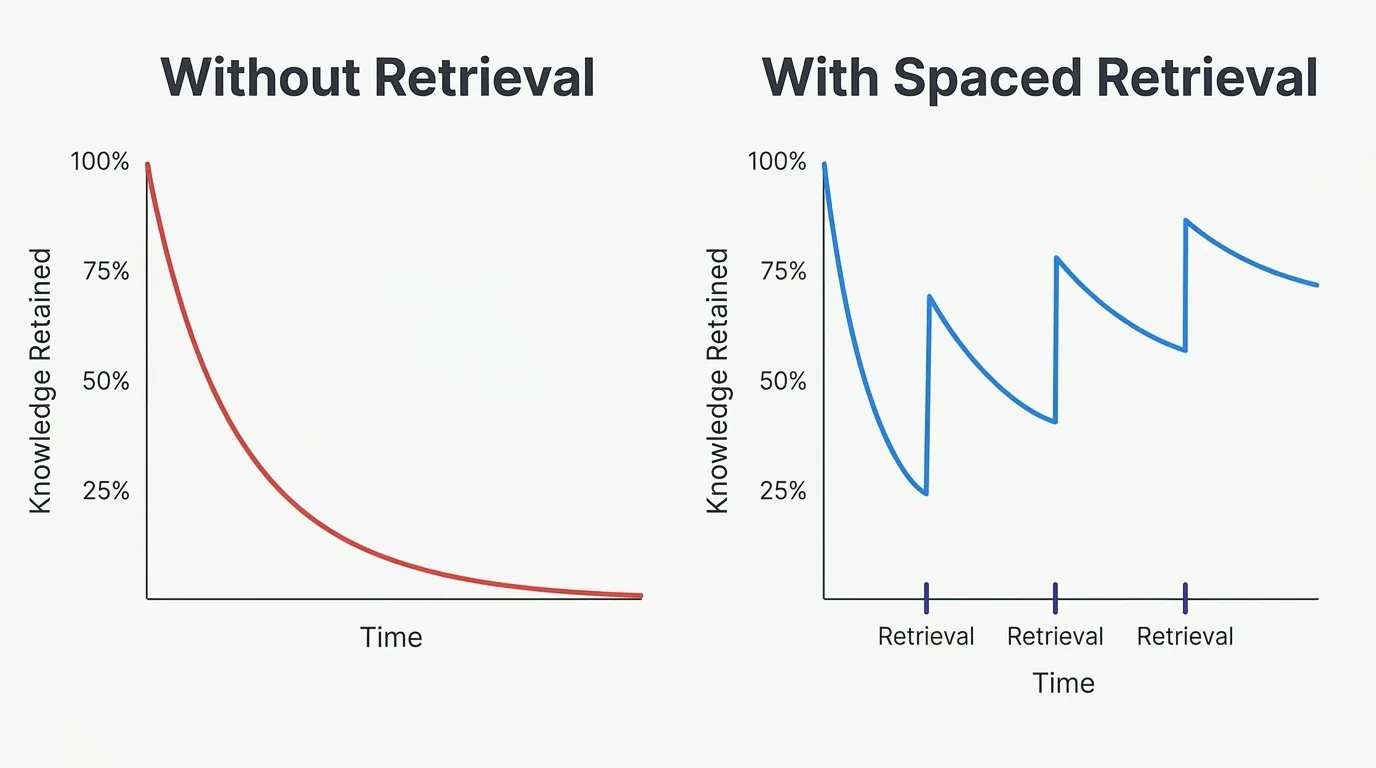
In the 1880s, Hermann Ebbinghaus memorised lists of nonsense syllables and tested how quickly he forgot them. The result, now called the forgetting curve, is steep: most of the loss happens in the first day or two, then it slows.
Real knowledge is not nonsense syllables, and it fades more gently. But the shape holds. Information you take in once and never use again leaves quickly.
That is not a flaw. Your brain is deciding what to keep based on what gets used. If you read something and never call on it again, the brain concludes it was not important. Retaining information means sending the opposite signal.
Your brain keeps what you use. Retention is the art of using things on purpose before you need them.
8 Ways to Retain Information
1. Test yourself instead of re-reading
This is the single most effective thing on this list. After reading, close the source and try to recall what it said. Answer questions. Write down what you remember on a blank page.
In a well-known 2006 study, students who tested themselves remembered 61% of a passage a week later. Students who re-read it remembered 40%. Same material, same time spent. We cover the details in our guides to retrieval practice and active recall techniques.
2. Space it out
Coming back to the same material several times, with gaps in between, beats one long session. A large 2006 review of more than 300 experiments found spacing improved retention across almost every condition tested. The longer you need to remember something, the longer the gaps can be.
A simple schedule: the next day, a few days later, a week or two later, a month later. This is the idea behind spaced repetition.
3. Explain it in your own words
Explaining an idea — to a colleague, to a friend, or out loud to no one — forces you to rebuild it rather than repeat it. Wherever you get stuck is where your understanding is weakest. Asking yourself why something is true, and how it connects to the rest, is called elaboration, and it deepens memory.
4. Connect it to what you already know
New information sticks when it has something to hang on. Ask: where have I seen this before? What does it contradict? What does it remind me of from my own work? Each link is another route back to the memory later.
5. Mix it up
Practising one type of problem over and over feels efficient. Mixing different types together — called interleaving — feels harder and works better, especially for learning to tell similar ideas apart. If you are learning three frameworks, practise choosing between them, not drilling each in turn.
6. Use it
The strongest signal you can send your brain is to apply an idea to a real problem. Use the negotiation technique in your next negotiation. Run the analysis method on this quarter's data. Application does two things: it makes the memory stick, and it shows you whether you actually understood it.
Being able to recall an idea and being able to use it are two separate skills, and both need practice.
7. Sleep on it
Sleep is when the brain consolidates what you learned during the day, moving it into longer-term storage. Studying late into the night at the expense of sleep trades tomorrow's memory for tonight's hours. Learning something in the evening and reviewing it the next morning is a good pattern.
8. Learn less, on purpose
This is the one nobody wants to hear. If you read fifty articles a month, you will not retain fifty articles. You may retain none of them well.
Pick the few ideas that actually matter to your work and give those the recall, spacing and practice above. Let the rest go. Retaining ten important ideas well is worth more than half-remembering a hundred.
What Doesn't Help as Much as It Feels
- Re-reading. It feels productive because the material becomes familiar. Familiar is not the same as remembered. More on why.
- Highlighting. Marking a sentence is not learning it. Highlights are useful only if you come back and test yourself on them.
- Saving it for later. A read-later list or note-taking system stores information. It does not put it into your head. See why your second brain remembers more than you do.
- Cramming. One long session works for tomorrow and fails for next month.
A Simple Routine
If you only take one thing from this article, take this loop:
- Read — something worth keeping.
- Recall — close it and say the main point from memory.
- Return — a few days later, recall again before re-reading.
- Apply — use it on a real problem within a couple of weeks.
That loop uses the four most powerful ideas in learning science at once. It costs a few minutes per idea. And it is the difference between having read something and knowing it.
Retention isn't what happens while you learn. It's what you do in the days after.
How LearnBetter Puts These Methods to Work
The methods in this article are well proven. The hard part is doing them every week, for everything worth keeping. LearnBetter is built to do most of it for you.
- Test yourself — it turns what you read into questions you answer from memory.
- Space it out — it schedules each concept to come back just before you would forget it, using FSRS, a modern spaced-repetition scheduler.
- Explain and connect — questions ask why and how, not just what, and concepts are grouped into topics so related ideas sit together.
- Mix it up and use it — questions move from recall to choosing which idea fits a new situation and judging where it fails.
- Learn less, on purpose — it picks out the key concepts from each reading and leaves the rest, so your reviews stay short.
You add what you are reading — an article link, a PDF or ebook, a Word document, a YouTube video or pasted text — and the Read, Recall, Return, Apply loop runs on its own.
This article is part of our guide to how to learn better — six science-backed habits for remembering and using what you read.
Frequently Asked Questions
Testing yourself (active recall) and spacing your reviews over time. A 2013 review of ten common study methods rated these two as the most effective; re-reading and highlighting were rated low.
The brain keeps information it is asked to use and drops what it is not. Information taken in once and never recalled again fades fastest in the first day or two — the pattern known as the forgetting curve.
Return to it at growing intervals — a day, a few days, a week or two, a month — and each time, try to recall it before looking. Using the information on a real problem also makes it last much longer.
Much less than it feels like it does. Re-reading makes material feel familiar, which is easily mistaken for remembering. Testing yourself on the same material for the same time produces far better retention.
Yes. Sleep helps the brain consolidate what you learned during the day into longer-term memory. Cutting sleep to study more usually costs more than it gains.
Far fewer than most people try to. Choosing the few ideas that matter most and reviewing those properly retains more useful knowledge than lightly reading many things.
Sources
- Ebbinghaus, H. (1885). Memory: A Contribution to Experimental Psychology.
- Roediger, H.L. & Karpicke, J.D. (2006). Test-enhanced learning: Taking memory tests improves long-term retention. Psychological Science, 17(3), 249–255.
- Cepeda, N.J., Pashler, H., Vul, E., Wixted, J.T., & Rohrer, D. (2006). Distributed practice in verbal recall tasks: A review and quantitative synthesis. Psychological Bulletin, 132(3), 354–380.
- Dunlosky, J., Rawson, K.A., Marsh, E.J., Nathan, M.J., & Willingham, D.T. (2013). Improving students' learning with effective learning techniques. Psychological Science in the Public Interest, 14(1), 4–58.
- Bjork, R.A. (1994). Memory and metamemory considerations in the training of human beings. In J. Metcalfe & A. Shimamura (Eds.), Metacognition: Knowing about Knowing (pp. 185–205). MIT Press.
- Brown, P.C., Roediger, H.L., & McDaniel, M.A. (2014). Make It Stick: The Science of Successful Learning. Harvard University Press.
Retain what you read, without the admin
LearnBetter picks out the key concepts from what you read, quizzes you on them, and brings them back at the right time. Free to start.
Get Started Free